

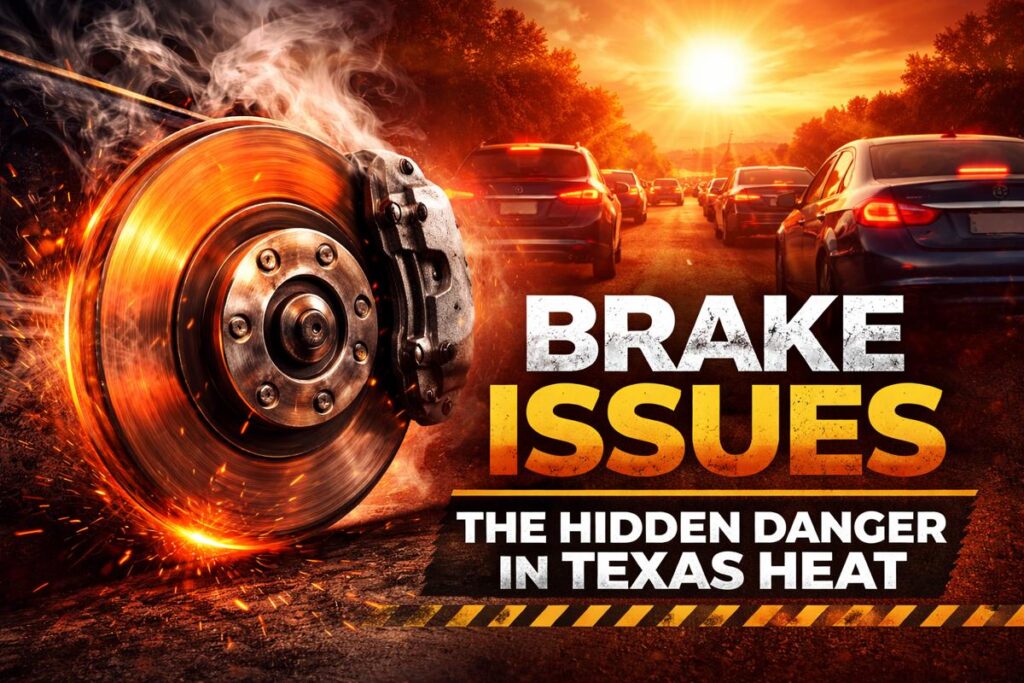
You’re heading south on US-75, traffic ahead is slowing, and you press the brake pedal. It goes down further than it should. The car doesn’t bite the way it normally does. You push harder. Still soft.
That sinking feeling in your stomach? It’s the right response. Because unlike a flat tire or a dead battery — problems that leave you stuck — brake failure puts you at risk while you’re still moving.
And in Dallas-Fort Worth, where summer pavement hits 150°F+, stop-and-go traffic is constant, and highway speeds push 80 mph, your brakes are under more stress than they were designed to handle. Brake fade, boiling brake fluid, and worn pads are some of the most dangerous — and most overlooked — consequences of driving in extreme Texas heat.
This guide covers exactly why brakes fail in the heat, what warning signs to watch for, and what to do if your brakes stop responding. It’s part of our series on the top 5 reasons cars break down in Texas heat.
Why Brakes Fail in Texas Heat
Your braking system works on two things: friction and hydraulic pressure. Extreme heat attacks both. Here’s how.
Brake Fade
Every time you press the brake pedal, the pads clamp down on the rotors and create friction. That friction generates heat — a lot of it. In normal conditions, the system dissipates that heat between stops. But in Texas summer traffic, you’re braking constantly. The heat builds up faster than it can escape.
When brake components overheat, the pads lose their ability to grip the rotors effectively. This is called brake fade — and it’s one of the leading causes of brake failure in hot weather. You’ll notice it as a longer stopping distance, a pedal that feels less responsive, or a need to press significantly harder to slow down. At extreme temperatures, overheating pads can release gases that form a thin layer between the pad and rotor surface — reducing friction even further. That’s why the car may not slow down even when the pedal still feels like it’s engaging.
Brake Fluid Boiling
Brake fluid is hygroscopic — it absorbs moisture from the air over time. Fresh fluid has a boiling point around 400°F. But as it absorbs water, that boiling point drops. In extreme heat, contaminated fluid can actually boil inside the brake lines.
When that happens, the liquid turns to gas. Gas is compressible. Liquid isn’t. So instead of a firm, responsive brake pedal, you get a soft, spongy one that sinks toward the floor. In severe cases, you lose hydraulic pressure entirely — and the brakes stop working.
This is why the brake pedal feels soft in hot weather — and why it’s one of the most dangerous symptoms to ignore.
Brake Pad Glazing
When pads overheat repeatedly, the binding resins in the pad material can melt and form a hard, glassy layer on the pad surface. This is called glazing. Glazed pads look shiny instead of rough, and they can’t generate the friction needed to stop the car effectively. You’ll notice inconsistent braking — sometimes it grips, sometimes it doesn’t.
Rotor Warping
Extreme heat causes rotors to expand. Rapid cooling — like driving through a puddle after hard braking — causes them to contract unevenly. Over time, this warps the rotor surface. Warped rotors cause vibration through the steering wheel and brake pedal, and they reduce braking efficiency. In DFW summer conditions, this cycle of heat and occasional rain makes warping more common.
Worn Pads Overheat Faster
Thin pads have less material to absorb and dissipate heat. If your pads are already worn, they’ll reach dangerous temperatures faster in summer conditions. This turns a “you should replace those soon” situation into a “your brakes might fail on the highway” situation. Don’t wait for the metal-on-metal grinding sound — by then, you’ve already damaged the rotors.
Warning Signs Your Brakes Are Failing
The most common signs of brake failure in hot weather include a soft or spongy brake pedal, longer stopping distances, a burning smell near the wheels, steering wheel vibration when braking, squealing or grinding noises, and the brake warning light on your dashboard. If you notice any of these during a Texas summer, get your brakes inspected immediately.
Let’s break each one down:
- Soft or spongy brake pedal — this usually means air or moisture in the brake lines, often caused by overheated or degraded brake fluid. It’s the most dangerous symptom because it directly affects stopping power.
- Car takes longer to stop — if you’re pressing the pedal at the same point but the car isn’t slowing as quickly, that’s brake fade. Don’t adjust your driving to compensate — fix the brakes.
- Burning smell after braking — that sharp, chemical smell means your pads or rotors are overheating. Pull over and let them cool. Continuing to drive can cause complete brake failure.
- Steering wheel vibration — pulsating or shaking when you brake points to warped rotors. It gets worse at higher speeds.
- Grinding or squealing noise — squealing usually means the pads are thin. Grinding means pad material is gone and metal is hitting metal. At that point, you’re damaging the rotors with every stop.
- Brake warning light — don’t ignore this. It can indicate low fluid, worn pads, or a hydraulic system problem. Get it checked the same day.
Brake problems are one of the most common reasons motorists call for roadside assistance — and in Texas heat, they escalate fast.
For a broader look at dashboard warnings, check out our guide on warning signs on your vehicle.
What to Do If Your Brakes Fail While Driving
This is the section you don’t want to need — but if you do, these steps could save your life.
- Stay calm and pump the brake pedal — rapid pumping can temporarily rebuild hydraulic pressure in the system, especially if the issue is brake fade or air in the lines.
- Downshift to a lower gear — shift to L, 2, or use manual mode on an automatic. Engine braking slows the car without using the brake pads at all.
- Apply the emergency/parking brake gradually — pull it slowly and steadily. Don’t yank it — a sudden application at speed can lock the rear wheels and cause a spin.
- Steer toward safety — aim for the shoulder, a parking lot, a side street, or any open space away from traffic. Use your hazard lights.
- Don’t turn off the engine — you’ll lose power steering and power brakes, making the car much harder to control.
- Once stopped, do not drive the car — brake failure is not something you “push through.” Call for help immediately.
If your brakes aren’t responding properly, every second counts. Don’t risk trying to “make it home” — that’s how accidents happen. Call for immediate roadside assistance and get off the road safely.
When to Call for a Tow
Brake problems are different from other breakdown situations. With a dead battery, you’re stuck. With failing brakes, you’re dangerous. Never attempt to drive a vehicle with compromised brakes to a repair shop.
Call for a tow if:
- The brake pedal goes to the floor
- You smell burning after stopping
- Brakes are grinding metal-on-metal
- The car pulls sharply to one side when braking
- The brake warning light stays on
- You’ve experienced any loss of braking response
Driving with failing brakes isn’t just risky for you — it puts every other driver on the road at risk too. A tow costs a fraction of what an accident costs.
Flag Towing provides 24/7 roadside assistance and flatbed towing across Dallas, Plano, Frisco, McKinney, and the entire North Texas area. If your brakes aren’t right, don’t risk it — call now for fast help anywhere in North Texas.
Why Brake Problems Are More Dangerous in Dallas-Fort Worth
DFW driving conditions create a worst-case scenario for brake systems.
High-Speed Highways
US-75, I-35, the Dallas North Tollway, and the George Bush Turnpike all see sustained speeds of 70–80 mph. At those speeds, the energy your brakes need to absorb during a stop is exponentially higher. Brakes that work fine at 40 mph can fade dangerously at 75 mph in extreme heat.
Constant Stop-and-Go Traffic
Stop-and-go traffic on US-75, I-35, and the George Bush Turnpike means you’re braking hundreds of times during a typical commute. Every application adds heat to the system. During peak summer, that heat never fully dissipates between stops — it just accumulates until something gives.
Extreme Ambient Temperatures
When it’s 105°F outside and the road surface is 150°F+, your brakes start at a higher baseline temperature before you even touch the pedal. The margin between normal operating temperature and dangerous overheating shrinks significantly.
Urban Heat Retention
Dense areas across Allen, Plano, and Frisco trap heat through asphalt, concrete, and buildings. Road surface temperatures in these areas can run 5–10°F higher than surrounding rural roads — which means more thermal stress on your brakes during every drive.
How to Prevent Brake Failure in Texas Heat
Brake failure is almost always preventable. Here’s what to prioritize.
Flush Brake Fluid Every 2 Years
This is the most important — and most neglected — brake maintenance item. Fresh fluid maintains a high boiling point. Old, moisture-contaminated fluid is a ticking time bomb in Texas heat. A brake fluid flush costs $100–$150 and takes about 30 minutes. Skipping it can cost you your brakes.
Replace Brake Pads Before They’re Worn Out
Most pads last 25,000–70,000 miles depending on driving conditions. In DFW stop-and-go traffic, expect the lower end of that range. Don’t wait for squealing — that’s already late. Have pads inspected every oil change and replace them when they hit 3mm thickness or less.
Get Regular Brake Inspections
A full brake inspection checks pads, rotors, calipers, fluid condition, and hoses. Do this at least twice a year in Texas — once before summer and once before winter. Most shops include it as part of a general service inspection.
Don’t Ride the Brakes
Keeping your foot lightly on the brake pedal in traffic generates constant, low-level heat that accelerates wear and can trigger fade. Instead, leave space and coast to slow down, then brake firmly when needed. One decisive stop is better for your brakes than 30 seconds of constant light pressure.
Use Engine Braking in Traffic
In heavy traffic or on long descents, shift to a lower gear and let the engine help slow the car. This takes load off the brake system and reduces heat buildup. It’s especially effective in stop-and-go crawls on I-35 or the DNT.
Avoid Aggressive Driving in Heat
Hard acceleration followed by hard braking is the fastest way to overheat your brakes. Maintain steady speeds, keep a safe following distance, and anticipate stops. Your brakes — and your passengers — will thank you.
For more summer driving tips, read our guide on avoiding breakdowns in Texas extreme weather.
The Cost of Ignoring Brake Problems
Brake maintenance is cheap. Brake failure is not.
- Brake pad replacement: $150–$300 per axle.
- Rotor replacement: $300–$600 per axle.
- Brake fluid flush: $100–$150.
- Caliper replacement: $300–$500 per caliper.
- Tow after brake failure: $75–$200.
- Accident caused by brake failure: thousands to tens of thousands — plus potential injury.
A $100 fluid flush and a $250 pad replacement could prevent a $10,000+ accident. Don’t gamble with brakes.
Why Choose Flag Towing for Brake Emergencies
When your brakes fail, you can’t drive to a repair shop. You need someone to come to you — fast.
Flag Towing provides emergency towing and roadside assistance across the entire DFW metro, 24/7. Our flatbed towing ensures your vehicle is transported safely without putting any stress on a compromised braking system.
Don’t risk it — call now for fast roadside help anywhere in North Texas.
Frequently Asked Questions
Can heat cause brakes to fail?
Yes. Extreme heat causes brake fade by reducing pad friction, and it can make brake fluid boil — both of which reduce or eliminate stopping power. In Texas summer conditions, these risks are significantly higher than in moderate climates.
What does a spongy brake pedal mean?
A soft or spongy brake pedal usually indicates air or moisture in the brake lines, often caused by overheated or degraded brake fluid. This is a serious safety issue — get it inspected immediately, especially during summer months.
Why do my brakes smell like they’re burning?
Overheating brake pads or rotors produce a sharp, chemical burning smell. This is a warning sign of brake fade. Pull over safely, let the brakes cool for at least 10–15 minutes, and avoid driving further if the smell persists or braking feels compromised.
What should I do if my brakes stop working while driving?
Pump the brake pedal rapidly to try rebuilding pressure. Downshift to a lower gear to use engine braking. Apply the parking brake gradually — don’t yank it. Steer to a safe location, turn on hazards, and call for emergency towing immediately. Do not attempt to drive the vehicle.
How often should brakes be inspected in Texas?
At least twice a year — before summer and before winter. If you drive daily in heavy DFW traffic, consider inspections every oil change. Brake fluid should be flushed every 2 years regardless of driving conditions.
Why do my brakes feel normal but the car doesn’t stop well?
This is brake fade. The pedal may feel like it’s engaging, but overheated pads can’t generate enough friction to slow the car effectively. In extreme cases, gases released by overheating pads create a barrier between the pad and rotor, further reducing stopping power. Pull over and let the brakes cool — and get them inspected before driving again.
Is it safe to drive with the brake warning light on?
No. The brake warning light can indicate low fluid, worn pads, or a hydraulic system problem — any of which can lead to brake failure. Get it checked the same day. If braking feels compromised in any way, stop driving and call for a tow.