

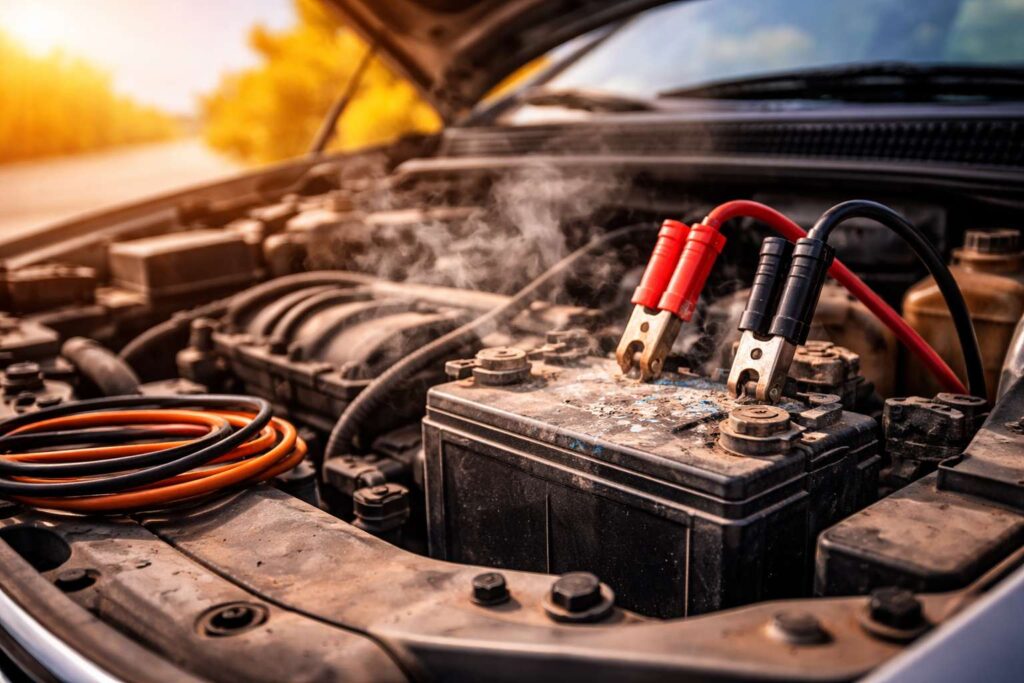
You come out of Target on a 103°F afternoon in Plano, toss the bags in the back seat, turn the key — and get nothing. No crank. No dashboard lights. Just silence and a parking lot that feels like a convection oven.
Dead battery. And unlike that slow leak in your tire or a coolant warning light, there was zero warning. It just… died.
Dead batteries are one of the most common reasons motorists call for roadside assistance — and in Texas summer, it happens without warning.
Here’s what most Dallas drivers don’t realize: summer heat kills more car batteries than winter cold. It’s not even close. While cold weather can expose an already weak battery, Texas heat actively destroys the chemistry inside it — accelerating corrosion, evaporating critical fluids, and cutting the lifespan in half. AAA responded to 1.83 million battery-related service calls during the summer of 2024 alone.
This guide breaks down exactly why your car battery dies in the heat, what to do when it happens, and how to stop it from happening again. It’s part of our series on the top 5 reasons cars break down in Texas heat.
Why Car Batteries Fail in Texas Heat
Your car battery is a chemical system. Lead plates sit in a sulfuric acid solution, and a controlled chemical reaction produces the electrical current that starts your engine and powers your accessories. Heat doesn’t just stress that system — it attacks it from multiple angles at once.
Electrolyte Evaporation
The fluid inside your battery — a mix of water and sulfuric acid — evaporates faster in extreme heat. When fluid levels drop, the lead plates become exposed. Exposed plates corrode faster, hold less charge, and eventually can’t produce enough current to start the engine. Under-hood temperatures in Texas regularly hit 140°F or higher during summer, which accelerates this process dramatically.
Accelerated Internal Corrosion
Heat speeds up corrosion on the internal grids and plates. This isn’t surface-level terminal corrosion you can see and clean — it’s happening inside the sealed battery case. Over time, this reduces the battery’s total capacity and can cause internal short circuits between cells.
Sulfation Buildup
Every time your battery discharges and recharges, small amounts of lead sulfate crystallize on the lead plates. In moderate temperatures, this is manageable. In Texas heat, sulfation accelerates. Those crystals harden and reduce the plate surface area available for reactions.
Overcharging from the Alternator
Your alternator’s voltage regulator can malfunction in extreme heat, pushing more voltage into the battery than it’s designed to handle. Chronic overcharging damages the plates and can cause the battery case to swell or crack. If your battery feels hot to the touch or looks bloated, this might be the cause.
Increased Electrical Demand
Texas summers mean your AC runs constantly, your phone is charging, the kids’ tablets are plugged in, and the infotainment system is going. All of that draws power. When you’re sitting in stop-and-go traffic on I-75, the alternator can barely keep up — and the battery fills the gap. Over time, that chronic drain wears it down.
How Long Do Car Batteries Last in Texas?
In cooler climates, a car battery can last 4–5 years. In Texas, expect 2–3 years. That’s not a rough estimate — that’s the reality of what sustained 100°F+ temperatures do to battery chemistry.
Here’s a stat that catches most people off guard: batteries in warm climates have a life expectancy of about 30 months, compared to 51 months in cold climates. And the damage is cumulative. A battery that barely survived last summer probably won’t make it through this one — even if it seems fine in the spring.
The sneaky part? Summer heat does the damage, but the battery often dies in winter. The cold doesn’t kill it — it just exposes the weakness that heat already created. So if you’re thinking “my battery made it through August, I’m good” — you might be wrong.
Signs Your Car Battery Is Dying
Most batteries give you warning signs before they fail completely. The problem is, most drivers don’t recognize them until they’re staring at a car that won’t start.
- Slow engine crank — the engine turns over sluggishly instead of firing up quickly. This is the most common early sign.
- Clicking sound when turning the key — the starter solenoid is trying to engage but there’s not enough juice to turn the engine.
- Dim headlights or interior lights — especially noticeable at idle or when the AC is running.
- Electrical glitches — windows moving slowly, radio resetting, dashboard flickering. These can all indicate low voltage.
- Dashboard battery warning light — if this comes on while driving, it usually means the charging system is struggling, not just the battery.
- Swollen or bloated battery case — heat has caused internal damage. Replace immediately.
- Rotten egg smell near the battery — that’s sulfuric acid leaking or off-gassing. Don’t ignore it.
For a deeper look at what your dashboard is trying to tell you, check out our guide on warning signs on your vehicle.
What to Do When Your Car Battery Dies in the Heat
Where you are and what tools you have will determine your next move. Here’s how to handle it.
Step 1: Try a Jump Start
If you have jumper cables and access to another vehicle (or a portable jump starter — which every Texas driver should own), try a jump first.
- Connect the red (positive) cable to the dead battery’s positive terminal, then to the working battery’s positive terminal.
- Connect the black (negative) cable to the working battery’s negative terminal, then to an unpainted metal surface on the dead car’s engine block — not the dead battery’s negative terminal. This prevents sparks near the battery.
- Let the working car run for 3–5 minutes.
- Try starting the dead car. If it starts, let it run for at least 20 minutes to recharge.
Worried about doing this in wet conditions? We’ve covered that: can you jumpstart a car in the rain?
Step 2: Don’t Repeat Failed Attempts
If the car doesn’t start after 2–3 jump attempts, stop. Repeated cranking on a completely dead battery can damage the starter motor — a $300–$600 repair you don’t need on top of a dead battery. It can also overheat the jumper cables.
Step 3: Call for Professional Help
If the jump doesn’t work, or you don’t have the tools, call for a professional jump start service. Flag Towing carries commercial-grade jump packs that can start vehicles standard cables can’t. We’re across the DFW metro within minutes.
If you’re stuck in a parking lot or on the roadside in 100°F heat, waiting isn’t just uncomfortable — it’s unsafe. Call now and get help on the way within minutes.
Step 4: Get the Battery Tested
A successful jump start doesn’t mean the battery is fine. It might hold enough charge to get you to an auto parts store — but it could die again the next time you park. Get it load-tested. Most auto shops do this for free. If the battery is more than 2 years old and failed once in Texas heat, replace it.
When You Need a Tow Instead of a Jump
Sometimes a dead battery is a symptom, not the problem. Call for a tow instead of a jump if:
- The battery won’t hold a charge after jumping — the car dies again within minutes of disconnecting cables. The battery or alternator is shot.
- You hear grinding or no sound at all — could be a starter motor failure, not just the battery.
- Electrical systems are haywire — dashboard lights flashing, gauges going crazy, AC cutting in and out. This points to alternator or wiring issues.
- The battery case is swollen, cracked, or leaking — this is a safety issue. Don’t try to jump a physically damaged battery.
- You smell sulfur or see smoke — get away from the vehicle. Something is seriously wrong.
- You’re in an unsafe location — a busy parking garage, highway shoulder, or anywhere that makes standing outside the car risky.
Flag Towing provides 24/7 roadside assistance and towing across Dallas, Plano, Frisco, McKinney, and the entire North Texas area.
Why Battery Failures Hit Harder in Dallas-Fort Worth
DFW has a specific combination of factors that make battery failure more common here than in most other metros.
Extreme Sustained Heat
It’s not just that it gets hot — it stays hot. Multi-week stretches above 100°F mean your battery never gets a break. For every 15°F above 77°F, battery lifespan can be cut in half. Do the math on a 105°F day and the numbers aren’t pretty.
Cars Parked in Direct Sun
Not everyone has a garage. Across Allen, Plano, and Frisco, thousands of cars sit in apartment complex lots and office parking lots baking in direct sunlight all day. Under-hood temperatures in a sun-parked car can exceed 140°F — even higher than the ambient air. That’s cooking your battery every single day.
Short Commutes and Stop-and-Go Traffic
Short drives are terrible for batteries. Your battery dumps a huge amount of energy to start the engine, and it needs sustained driving (20+ minutes) to fully recharge. If your commute is a 10-minute hop through Plano surface streets or a stop-and-go crawl on US-75 and the Dallas North Tollway, your battery is chronically undercharged — and that accelerates sulfation and shortens its life.
Heavy Electrical Load
AC on max, seat coolers running, dashcam recording, phone charging, kids streaming videos in the back seat. That’s a normal DFW summer commute, and it puts enormous strain on both the battery and the alternator. In traffic, where engine RPMs are low, the alternator can’t keep up — and the battery fills the gap until it can’t anymore.
How to Prevent Battery Failure in Texas Heat
Most battery failures in summer are preventable. Here’s what actually works.
Get Your Battery Tested Before Summer
Most auto parts stores and mechanics will load-test your battery for free. Do this in April or May, before peak heat arrives. A battery that tests marginal in spring will almost certainly fail by August. If it’s testing below 12.4 volts at rest, replace it now.
Replace Proactively at 3 Years
In Texas, don’t wait for your battery to die. If it’s 3+ years old, budget for a replacement. The $150–$200 you spend on a new battery is nothing compared to the cost (and misery) of being stranded in a parking lot at 4 PM in July. Check the date code on your battery — the first two characters typically indicate month and year of manufacture.
Keep Terminals Clean
That white or green crusty buildup on your battery terminals isn’t just ugly — it’s blocking electrical current. Clean them with a wire brush and a baking soda/water paste every few months. Apply dielectric grease afterward to slow future corrosion. This takes 5 minutes and costs basically nothing.
Park in Shade or a Garage
According to the EPA, shaded surfaces can be 20–45°F cooler than surfaces in direct sunlight. Parking in shade or a garage significantly reduces under-hood temperatures and extends battery life. If shade isn’t available, a reflective windshield cover helps, but it doesn’t protect the battery as effectively as actual shade.
Take Longer Drives When Possible
If your daily routine is all short trips, try to take one sustained drive (20+ minutes) at least a couple times a week. This gives the alternator enough time to fully recharge the battery. Highway driving at moderate RPMs is ideal.
Reduce Electrical Load at Startup
Before turning the key, switch off the AC, radio, headlights, and seat coolers. Let the battery focus all its energy on starting the engine. Once the car is running and the alternator is spinning, turn accessories back on one at a time.
Consider a Battery Designed for Hot Climates
Some manufacturers make “South” versions of their batteries with higher electrolyte-to-lead ratios for better heat durability. AGM (Absorbent Glass Mat) batteries also tend to handle heat better than traditional flooded batteries, though they cost more upfront. Ask your mechanic what’s best for your vehicle.
For more on keeping your car running in extreme conditions, read our guide on avoiding breakdowns in Texas extreme weather.
The Cost of Ignoring Battery Health
Here’s what you’re looking at when a dead battery cascades into bigger problems:
- New battery: $150–$250 — the cheapest outcome.
- Jump start service: $50–$100.
- Tow to a repair shop: $75–$200 depending on distance.
- Starter motor damage from repeated cranking: $300–$600.
- Alternator replacement: $500–$800.
- Electrical system diagnostics: $100–$200.
- Being stranded in 105°F heat: priceless, and not in a good way.
A $0 battery test at AutoZone in May could save you $1,000+ in August. The math speaks for itself.
Why Choose Flag Towing for Battery Emergencies
When your car won’t start in a sun-baked parking lot or on a highway shoulder in 100+ degree heat, you need help fast — not in 45 minutes.
Flag Towing provides professional jump start service and roadside assistance across the entire DFW metro, 24/7. We carry commercial-grade equipment that works when your neighbor’s jumper cables won’t. And if the battery is beyond saving, we’ll tow you safely to your mechanic or dealership.
Don’t sit in the heat hoping someone walks by with cables. Call now for fast roadside help anywhere in North Texas.
Frequently Asked Questions
Can hot weather kill a car battery?
Yes. Heat accelerates electrolyte evaporation, internal corrosion, and sulfation — all of which degrade the battery from the inside out. Texas heat is harder on batteries than winter cold. In fact, most “winter” battery failures are actually caused by damage that accumulated during the previous summer.
How long do car batteries last in Texas?
Typically 2–3 years, compared to 4–5 years in cooler climates. Batteries in warm climates average about 30 months of life versus 51 months in cold-climate states. If your battery is over 3 years old in DFW, get it tested.
What are the warning signs of a dying car battery?
Slow engine crank, clicking when turning the key, dim headlights, flickering dashboard, electrical glitches, and a swollen or bloated battery case. If you notice any of these — especially during summer — get the battery tested immediately.
Why won’t my car start after sitting in the heat?
Prolonged heat exposure accelerates battery discharge. A battery that’s already weakened from age, sulfation, or low fluid levels can lose enough charge while parked in the sun to fail completely. Cars parked in direct sunlight experience under-hood temperatures above 140°F, which compounds the problem.
Should I try to jump start a car in extreme heat or call for help?
If you have the tools and know the process, a jump start is fine. But if the battery is physically damaged (swollen, leaking, cracked), don’t attempt it — call for professional roadside assistance. And if the car dies again after jumping, you need a tow, not another jump.
Why does my car battery die faster in Texas than other states?
Extreme temperatures accelerate every form of internal battery damage — electrolyte evaporation, corrosion, and sulfation all happen faster in sustained 100°F+ heat. Batteries in Texas last about 30 months on average, compared to 51 months in cooler states. The higher the heat, the shorter the battery lifespan.