

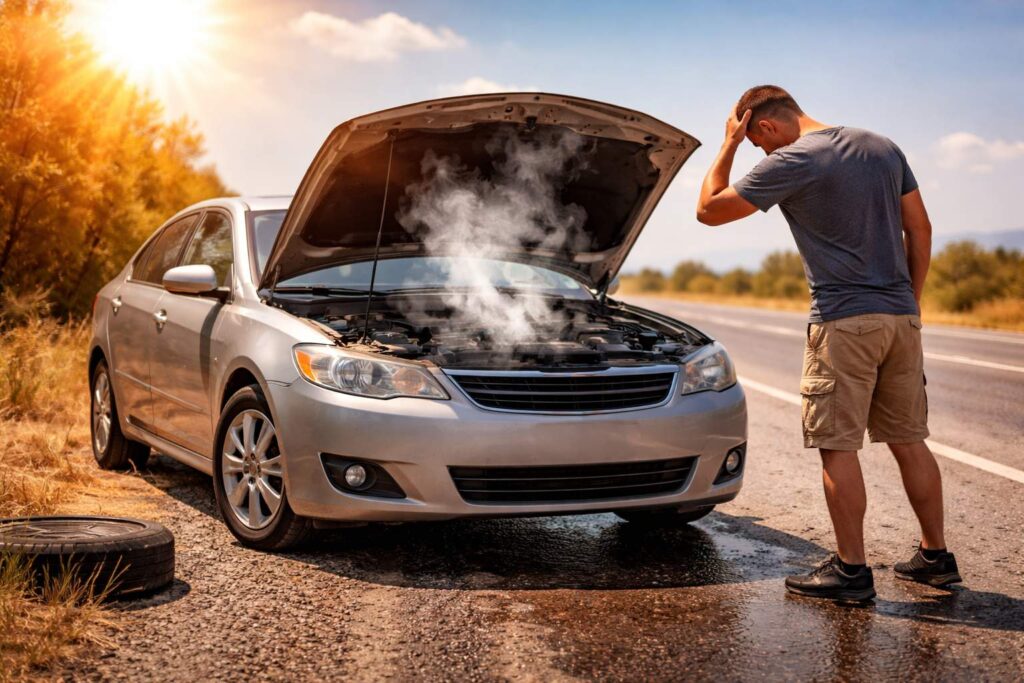
You’re stuck in bumper-to-bumper traffic on 75, the dashboard temp gauge is creeping into the red, and there’s a faint sweet smell coming through the vents. Sound familiar?
With North Texas summers routinely pushing past 100°F, your engine is fighting a battle it wasn’t designed to win — especially in stop-and-go Dallas traffic. Overheating is one of the top reasons vehicles break down during extreme heat, and how you respond in those first few minutes can mean the difference between a quick cooldown and a blown head gasket.
This guide walks you through exactly what to do, what causes overheating in the first place, and how to avoid it happening again. It’s part of our series on the top 5 reasons cars break down in Texas heat — so if you want the full picture, start there.
How to Tell Your Car Is Overheating
Don’t wait until steam is pouring from under the hood. Your car gives you warning signs well before things get critical:
- Temperature gauge climbing toward red — this is your earliest and most reliable indicator. If it’s past the midpoint and still rising, pay attention.
- Steam or vapor from under the hood — coolant is boiling off, which means you’re already past the safe zone.
- A sweet, syrupy smell — that’s coolant leaking or burning on hot engine components. Antifreeze has a distinct sugary scent you won’t confuse with anything else.
- Sudden loss of engine power — your car’s computer may start pulling power to protect the engine. If acceleration feels sluggish for no reason, overheating could be the cause.
- Dashboard warning light — newer vehicles have a dedicated coolant temperature warning. If that light comes on, don’t second-guess it.
For a deeper dive on what your dashboard is telling you, check out our guide on warning signs on your vehicle.
What to Do When Your Car Overheats (Step-by-Step)
Here’s the thing: panicking makes it worse. Follow these steps in order, and you’ll protect both your engine and yourself.
Step 1: Turn Off the A/C and Crank the Heat
Yeah, this sounds miserable in a Texas summer. But your heater core pulls heat away from the engine — it’s basically a second radiator. Turn the heat to max and open the windows. You’ll be uncomfortable for a few minutes, but your engine will thank you.
Step 2: Pull Over Safely
Don’t try to “make it” to the next exit or push through traffic. Get off the road as soon as you safely can — a parking lot, a side street, even the shoulder if that’s your only option. The longer you drive with an overheating engine, the more damage you’re causing.
Step 3: Turn Off the Engine
Once you’re stopped, kill the engine and let it cool for at least 20–30 minutes. Don’t open the radiator cap while it’s hot — the coolant is under pressure, and you can get seriously burned. Just let it sit.
Step 4: Check Coolant (Once Cool)
After things cool down, check the coolant reservoir. If it’s empty or way below the minimum line, you may have a leak. If you’ve got water or coolant with you, add some. This might get you to a repair shop — but it’s a temporary fix, not a solution.
Step 5: Call for Help If Needed
If the temperature gauge climbs again after restarting, or if the car won’t start at all, don’t force it. That’s when you need professional towing. Driving an overheating vehicle can warp the cylinder head, crack the engine block, or destroy the head gasket — repairs that easily run $2,000 to $4,000+.
While you’re waiting for help, stay safe. Move away from traffic, turn on your hazard lights, and stay visible. We’ve put together a full set of tips on staying safe while waiting for a tow truck.
Can You Keep Driving with an Overheating Engine?
Short answer: no. And here’s why it matters.
Your engine operates within a tight temperature range — usually between 195°F and 220°F. Once you blow past that, metal components start expanding beyond their tolerances. Aluminum cylinder heads warp. Gaskets fail. Coolant leaks into the combustion chamber. Each mile you drive with an overheating engine compounds the damage exponentially.
A $150 tow is a lot cheaper than a $3,500 engine rebuild. So if the gauge is in the red and not coming down, pull over and call for roadside assistance.
What Causes Car Overheating in Texas Heat?
Overheating isn’t random. There’s always an underlying cause, and Texas heat just accelerates it. Here are the most common culprits:
Low Coolant or Coolant Leaks
This is the number one cause. Coolant degrades over time, and small leaks from hoses, the radiator, or the water pump can slowly drain the system. In extreme heat, even being slightly low on coolant puts your engine at risk. According to AAA, cooling system failures account for roughly 40% of summer roadside breakdowns nationwide.
Faulty Thermostat
The thermostat regulates coolant flow. If it sticks closed, coolant can’t circulate through the radiator, and engine temperature spikes fast. A stuck thermostat is one of the cheaper fixes (usually $150–$300), but ignoring it leads to much bigger problems.
Radiator Problems
Clogged, corroded, or damaged radiators can’t dissipate heat effectively. Bugs, road debris, and years of mineral buildup all reduce radiator efficiency. If you’ve never had your radiator flushed, it’s probably overdue.
Broken or Worn Hoses and Belts
Rubber degrades faster in extreme heat. A cracked hose can leak coolant. A worn serpentine belt can cause the water pump to stop circulating. These are things a mechanic can catch during a routine inspection — before they leave you stranded.
Water Pump Failure
The water pump keeps coolant moving through the system. When it fails, coolant sits stagnant and can’t pull heat from the engine. You’ll usually hear a whining or grinding noise before it goes completely — that’s your cue to get it checked.
Head Gasket Issues
A failing head gasket can cause coolant to leak internally, meaning your reservoir looks fine but the engine is still overheating. White smoke from the exhaust and milky residue on the oil cap are telltale signs. This is a serious repair — get to a mechanic immediately.
Why Overheating Is Worse in Dallas-Fort Worth
It’s not just the heat. It’s the combination of factors that make DFW uniquely tough on cooling systems:
- Stop-and-go traffic — Dallas has some of the worst traffic congestion in Texas. When you’re barely moving, there’s almost no airflow through the radiator. Your cooling fan has to do all the work, and in 105°F ambient temperatures, it’s fighting a losing battle.
- Highway driving in extreme heat — Long stretches on I-35, US-75, or the DNT during peak summer put sustained load on your engine. The pavement itself radiates heat back up, pushing under-hood temperatures even higher.
- Urban heat island effect — Downtown Dallas and dense suburban areas like Plano, Frisco, and North Dallas trap more heat than surrounding areas. Asphalt, concrete, and buildings absorb and re-radiate heat, pushing local temps 5–10°F higher than nearby rural areas.
- Extended heat waves — North Texas regularly sees multi-week stretches above 100°F. Your cooling system doesn’t get a break overnight when lows only drop to the 80s.
Breakdowns spike during afternoon rush hour on extreme heat days. If you can avoid driving between 2–6 PM during a heat advisory, do it.
When to Call a Tow Truck
Not every overheating episode needs a tow. But these situations absolutely do:
- Steam is actively pouring from under the hood
- The car won’t restart after cooling down
- The temperature gauge goes right back to red after restarting
- You see coolant pooling under the vehicle
- You’re stuck in heavy traffic or an unsafe location (highway shoulder, no shoulder at all)
- You smell something burning — not just sweet coolant, but an acrid, hot-metal smell
In any of these cases, don’t risk driving. Flag Towing provides emergency towing across North Texas, 24 hours a day. We cover McKinney, Allen, Plano, Frisco, and the entire DFW metro.
How to Prevent Your Car from Overheating
A little prep goes a long way — especially before Texas summer hits. Here’s what actually moves the needle:
Stay on Top of Coolant
Check your coolant level at least once a month. Look at the reservoir — if it’s below the minimum line, top it off. If you’re constantly adding coolant, you’ve got a leak somewhere. Get it inspected before summer.
Get a Cooling System Flush
Most manufacturers recommend a coolant flush every 30,000 miles or every 2–3 years. Fresh coolant maintains proper boiling and freezing points and prevents internal corrosion. This is cheap maintenance that prevents expensive problems.
Inspect Belts and Hoses
Have your mechanic check rubber components for cracks, bulges, or soft spots. Hoses that are spongy or belts that are frayed are about to fail — and they always fail at the worst possible time.
Watch Your Temperature Gauge
Get in the habit of glancing at it regularly, especially in summer. If you notice it trending higher than normal — even if it hasn’t hit the red — that’s an early warning worth investigating.
Keep an Emergency Kit in the Car
During Texas summers, carry a gallon of water or premixed coolant, a flashlight, and a basic roadside kit. It won’t fix a serious problem, but it can buy you enough time to get off the highway safely.
For more on staying prepared, read our full guide on avoiding tow trucks in extreme Texas weather.
What Happens If You Ignore Engine Overheating?
Let’s be blunt about the stakes. Continuing to drive an overheating car can cause:
- Warped cylinder head — $1,500–$2,500 repair, sometimes more depending on the vehicle.
- Blown head gasket — $1,200–$2,000 for the repair itself, plus diagnostic costs.
- Cracked engine block — this is often a total loss. You’re looking at $3,000–$5,000+ or an engine replacement.
- Seized engine — if coolant loss leads to oil breakdown, internal components can weld themselves together. At that point, you’re buying a new engine or a new car.
Compare any of those to the cost of a tow and a cooling system repair, and the math is obvious. Pull over. Call for help.
Why Choose Flag Towing for Overheated Vehicles
When you’re stuck on the side of the road in 100+ degree heat, you need someone who shows up fast and handles your vehicle with care.
Flag Towing has been serving the North Texas community with 24/7 towing and roadside assistance for years. We know these roads, we know this heat, and we know how to get you off the highway and to a mechanic safely. Our flatbed towing keeps overheated vehicles secure during transport — no additional stress on an already damaged engine.
We serve Plano, Frisco, McKinney, Allen, Dallas, and the surrounding areas. Call us any time — day or night.
Frequently Asked Questions
Why does my car overheat more during Dallas summers?
Ambient temperatures above 100°F combined with stop-and-go traffic reduce your cooling system’s ability to dissipate heat. The urban heat island effect in the DFW metro makes it even worse, pushing local temps several degrees higher than surrounding areas.
How long should I wait before checking the engine after it overheats?
Wait at least 20–30 minutes before opening the hood or touching the radiator cap. The cooling system is pressurized, and opening it too soon can cause boiling coolant to spray out and cause serious burns.
Can overheating damage my engine permanently?
Yes. Even a single severe overheating episode can warp the cylinder head or blow the head gasket. Repeated overheating almost always causes cumulative damage. The longer you drive with the gauge in the red, the higher the risk of irreversible harm.
Is it safe to add water to an overheating car?
Only after the engine has cooled down. Adding cold water to a hot engine can cause thermal shock and crack the engine block. Wait until the temperature drops, then add water or coolant slowly. This is a temporary fix — get to a mechanic as soon as possible.
How much does it cost to fix an overheating car?
It depends on the cause. A thermostat replacement runs $150–$300. A radiator replacement is $400–$800. A blown head gasket repair can hit $1,200–$2,500. Catching problems early with routine maintenance is far cheaper than emergency repairs.
Should I call a tow truck or try to drive to a mechanic?
If the temperature gauge returns to normal after cooling down and stays there, you might be okay to drive short distances. But if it climbs again, or if you see steam, leaking fluid, or the car won’t restart — call for a tow. Flag Towing offers fast emergency towing across the DFW area, 24/7.